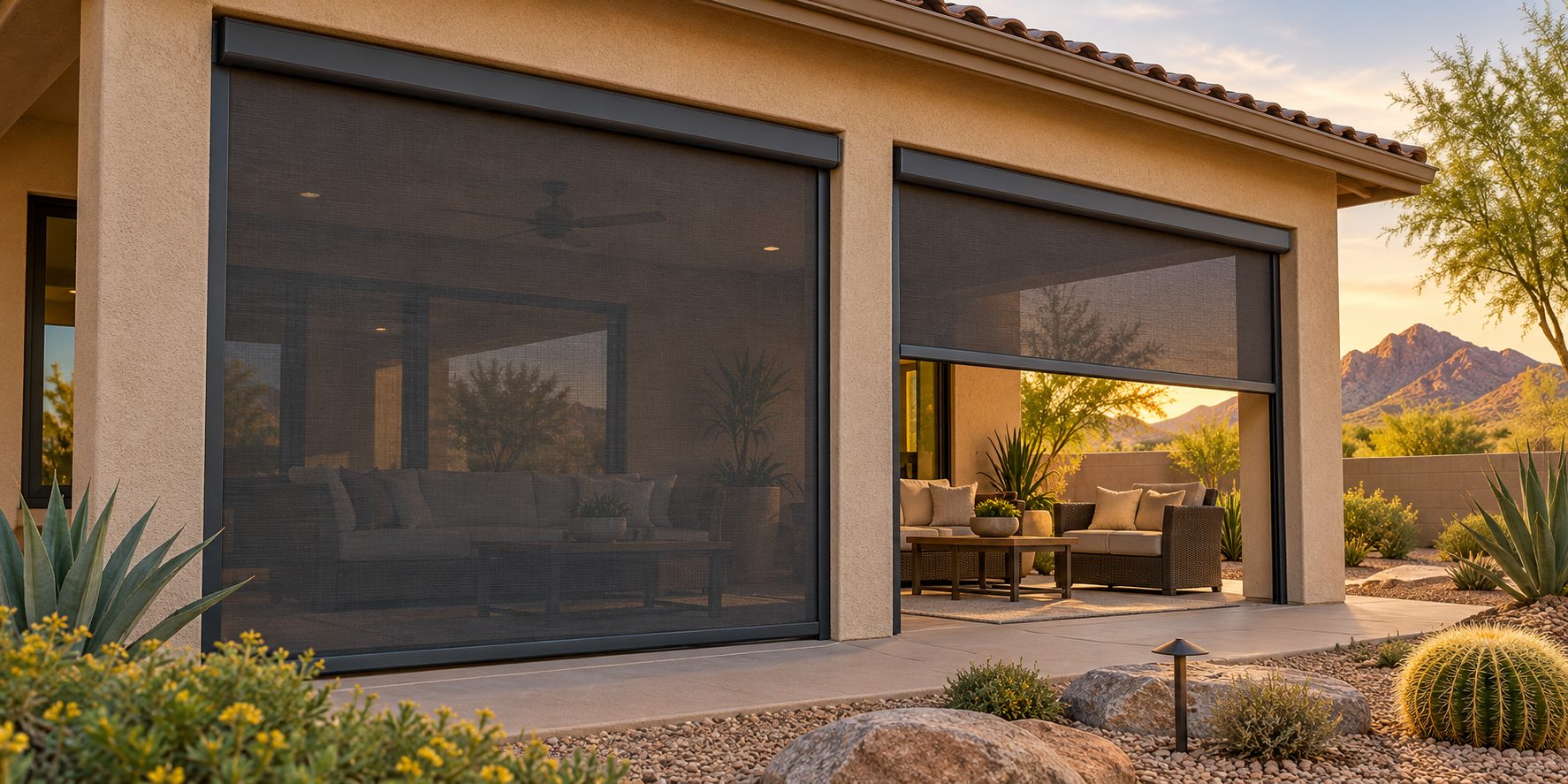
Scenario 1: West-facing covered patio with afternoon glare
A covered patio blocks overhead sun well, but on a west-facing exposure the low afternoon sun comes in sideways under the roof. The result is glare on the table and seating right at the hours most people want to be outside.
Motorized patio shades are a common fit here because they drop vertically at the edge of the patio cover, blocking that low sun while the roof continues to handle overhead light. They lower when the sun is a problem and raise out of sight when it is not.
Scenario 2: Daytime privacy without losing airflow or the view
On close-set Mesa lots, the patio can feel exposed to neighboring yards. Shade fabric openness is the main tool here: a more open fabric keeps more of the view and airflow, while a tighter fabric gives deeper shade and more daytime privacy.
There is a trade-off worth understanding before choosing. Shade fabrics generally provide more privacy during the day, when it is brighter outside. At night, with lights on inside the patio, people outside may be able to see in — so if nighttime privacy matters, discuss fabric choice with that in mind.
- More openness: keeps the view and breeze, lighter shade
- Less openness: deeper shade, more daytime privacy
- Ask to see fabric samples in person before deciding
Scenario 3: Flexible shade for a seating area
Some patios need shade only at certain hours, or across several openings at once. Motorized shades with side tracks hold the fabric steady along the edges, and group controls let several shades run together from one remote or wall control — useful when the sun moves across a wide patio.
If the area you want shaded has no roof over it at all, the answer is different: a retractable awning extends outward from a wall to create overhead shade where no patio cover exists, and retracts when you want the open sky back. Many homes end up with both — shades on the covered patio, an awning over an exposed doorway or deck.
What any of these solutions depend on
Whichever direction you go, a few practical factors shape the project.
- Measurements: the installer's final measurement of each clear opening is what the order should be built on
- Structural backing: shades anchor into beams, posts, headers or masonry — stucco is a surface finish, so anchors need suitable backing behind it
- Power: motorized shades need a power source, and the quote should say clearly what electrical work is included
- Wind: outdoor shades should be operated per the manufacturer's instructions, including raising them during Arizona monsoon storms
What affects cost
There is no honest single price, because every patio differs. The main drivers are opening dimensions, the number of openings, fabric line and openness, side retention type, mounting surface, power routing and control choices. Our cost guide breaks each of these down so you can compare written quotes on equal terms.
See what fits your patio
We measure your openings in person, walk through fabric and control options and give you a written quote for your home — free and with no obligation.